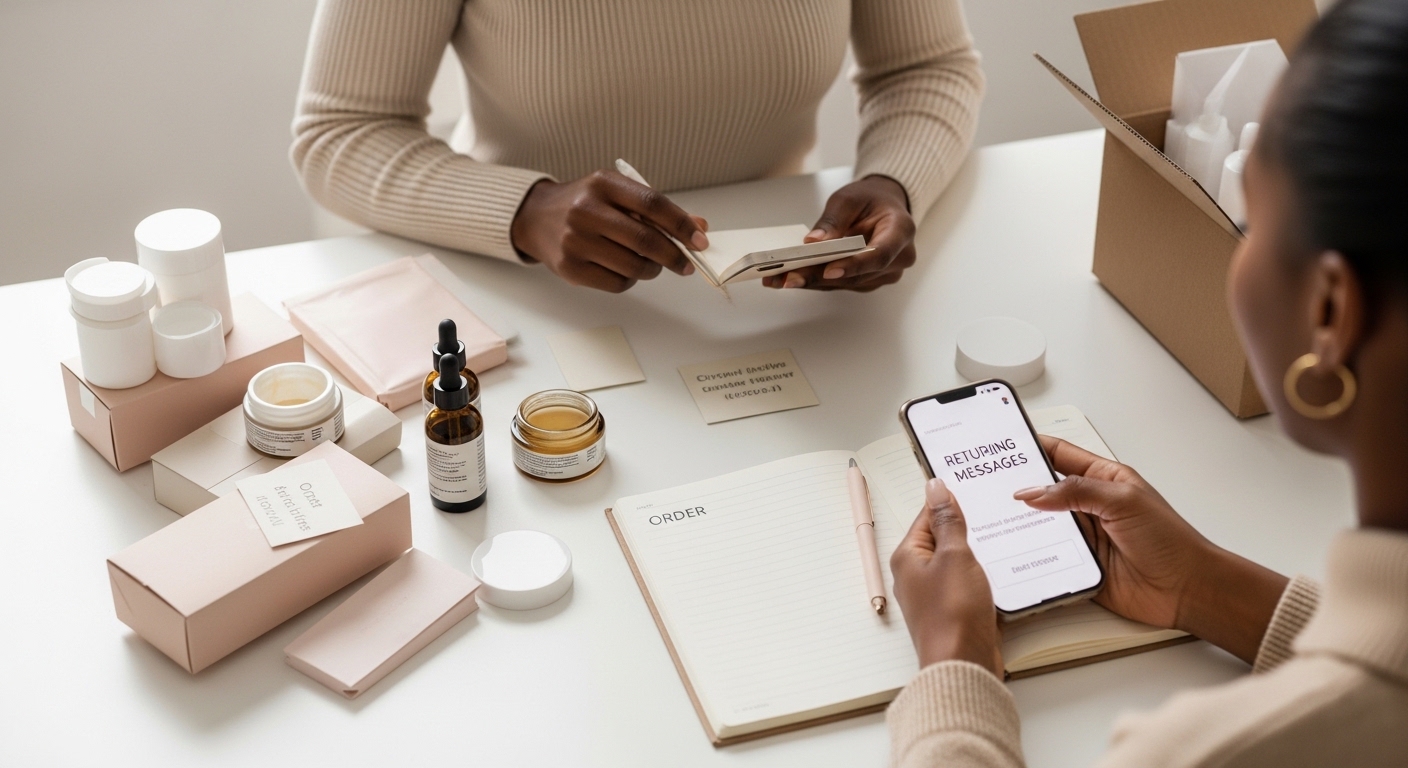
How to Get Repeat Customers for a Small Beauty or Skincare Business
Getting repeat customers for a skincare business is one of the most important ways to build steadier sales without constantly chasing new buyers.
There is a moment most small beauty and skincare business owners know very well.
Someone places an order. You package it carefully. You send updates. You make sure delivery goes smoothly. The customer receives it and sends a message saying they love it. Maybe they even post it. Maybe they say, “I will definitely come back for more.”
For a few hours, or a few days, that feels like progress.
Then nothing happens.
No second order. No question about restock. No message asking what else you recommend. No friend referred. Just silence.
So you go back to what feels urgent. You post again. You create content again. You try to attract new people again. You start explaining the same product to fresh strangers again. And without saying it out loud, you begin to accept this as normal.
It should not be normal.
One of the costliest habits in a small product business is constantly replacing customers who should have come back.
That is the real pressure behind inconsistent sales. It is not always that people are not interested. It is often that too many first purchases never become second purchases.
And when that happens, the business keeps running on effort instead of momentum.
A small beauty or skincare business becomes easier to grow when customers return. Not because repeat customers solve every problem, but because they reduce how often you have to start over.
This article will show you how to get more repeat customers in a way that is practical, realistic, and suited to the way many small businesses actually sell. Especially if most of your selling happens through Instagram, WhatsApp, referrals, or direct messages.
Why Repeat Customers Matter in a Skincare Business
When business owners think about growth, they usually think about getting more people to notice the brand.
More followers. More reach. More views. More people asking for price.
That sounds sensible. And to some extent, it is.
But there is a quieter question that matters just as much.
What happens after the first sale?
Because if a business keeps getting first time buyers but very few return, growth stays fragile. Sales may come in, but they do not settle. Every month starts to feel like a reset. Every dry spell feels personal. Every drop in orders creates panic.
A business with repeat customers feels different.
It has more stability. More predictability. More breathing room.
That is because a returning customer is easier to sell to than a stranger. They already crossed the hard bridge once. They already noticed you, considered you, trusted you enough to pay, and used your product. The biggest barrier has already been removed.
You are no longer trying to convince them that you are real.
You are reminding them that you are worth returning to.
That is a very different kind of sale.
It is also a more profitable kind of sale. Not only because it often costs less effort, but because repeat customers tend to trust your recommendations more, buy faster, and refer more easily.
In other words, repeat customers do not just buy again.
They make the business easier to run.
Why customers do not come back even when they liked the product
This is where many business owners get discouraged.
A customer bought. The product was good. There were no complaints. So why did they disappear?
The easy answer is to assume they lost interest or found something better.
Sometimes that is true.
But often, the real answer is much more ordinary.
People get distracted.
They get busy.
They forget where they bought something from.
They mean to reorder and never get around to it.
They switch attention to whoever is visible at the moment they need to buy again.
You have probably done this yourself.
You bought something you genuinely liked. You used it. It worked. And yet you did not go back to that exact seller. Not because the experience was bad. But because life moved on and the business was not present when you were ready to buy again.
That happens to your customers too.
So before you blame product quality, it helps to look at the full picture.
Here are some of the most common reasons customers do not return.
1. They were satisfied, but not anchored
The product was fine. The experience was fine. Nothing went wrong.
But nothing stood out enough to create memory, trust, or attachment.
If buying from you felt almost the same as buying from any other seller, the customer has no real reason to choose you again.
A good product matters. But a memorable buying experience matters too.
2. You disappeared after the sale
Many small businesses are warm and responsive before payment, then quiet after delivery.
Not intentionally. Just because the owner is busy chasing new orders.
But from the customer’s side, that silence says something.
It says this was a transaction, not a relationship.
Customers are more likely to return when they feel remembered.
3. You did not understand the usage cycle
A person who buys a body butter, cleanser, scrub, hair oil, or serum will not reorder at random. They will reorder when the product is almost finished, when their need returns, or when your reminder appears at the right moment.
If you do not know roughly how long your product lasts, you will miss the best time to follow up.
And if you miss the best time, someone else may get the sale.
4. Reordering feels like work
Sometimes a customer wants to buy again, but the process feels tiring.
They do not know if the product is available.
They do not know the current price.
They are not sure whether you still sell that item.
They have to start the conversation all over again.
Even a willing customer can drop off when buying feels inconvenient.
5. You stayed silent unless you were selling
If the only time customers hear from you is when you want to push a promo or announce a discount, the relationship stays shallow.
People come back more easily when your business stays useful, visible, and relevant between purchases.
What repeat customers actually need from you
Repeat customers do not need perfection.
They need confidence.
Confidence that the product works. Confidence that you care. Confidence that coming back will be easy.
That confidence usually rests on three things.
1. A product they trust
This is the foundation.
If the product disappoints, no follow up system will fix that. But if the product works and customers are satisfied, then your next job is to support the trust you have already earned.
2. A business that feels human
People are more likely to return to businesses that feel attentive, thoughtful, and consistent.
This does not mean pretending to be close friends with every customer.
It means simple things done well. Clear communication. A check in after delivery. Useful guidance on how to get the best result from the product. Remembering what they bought.
3. Timely reasons to come back
Many repeat purchases are lost because nobody created a natural next step.
A reminder. A check in. A useful suggestion. A gentle reorder prompt. A recommendation for the next product in the routine.
Customers often need less persuasion than business owners think. What they need is timing.
Common mistakes that quietly reduce repeat purchases
Before building a better system, it helps to see the mistakes that get in the way.
These are common, especially in small businesses where one person is doing almost everything.
1. Treating each sale as complete
The order came in. Payment was made. Delivery happened. So the process feels finished.
But the sale is not complete if your goal is to build a customer base instead of a string of one time transactions.
The real question after every order is this:
What will make it easy and natural for this customer to buy again?
2. Never tracking who bought what
If you do not keep even a simple record of what each customer bought and when they bought it, follow up becomes guesswork.
You cannot remind people well if you have no idea what they purchased, how often they use it, or when they are likely to need it again.
A notebook, spreadsheet, or simple customer list is enough to start.
3. Focusing only on new customer content
Many businesses create content as if every viewer is a stranger.
What about the customer who already bought from you?
What are you posting that helps them use the product better, remember your brand, trust your expertise, or consider a second purchase?
If all your content is designed only to attract new people, existing customers slowly drift away.
4. Waiting for customers to remember you on their own
This is one of the biggest myths in small business.
You assume that if the product was good, they will come back when they need it.
Some will.
Many will not.
Not because they disliked you. Simply because people forget.
A good business does not rely on memory alone.
5. Making every follow-up feel like a sales push
Customers can tell when a message is purely about extracting another order.
That is why follow up works best when it feels useful, timely, and considerate.
Not every message should say, “Please buy again.”
Some should say,
- “How is the product working for you?”
- Some should say, “Here is how to get better results from what you bought.”
- “You may be close to running out, so I wanted to check in.”
That feels different.
Because it is different.
A Simple Repeat Customer System for a Skincare Business
You do not need complex software to improve repeat purchases.
You need a process.
A process makes repeat sales less dependent on memory, mood, or luck.
Here is a simple system you can start using.
Step 1. Make the first purchase feel solid and considered
Repeat sales begin with the first experience.
That includes the product itself, but also everything around it.
- Was communication clear?
- Was the customer updated?
- Did the product arrive in good condition?
- Did they know how to use it?
- Did the experience feel thoughtful?
A small handwritten note. A clear usage guide. A simple thank you message after delivery. These details do not need to be expensive. They need to be deliberate.
People may forget a decent product.
They are less likely to forget a decent product paired with a good experience.
Step 2. Follow up after delivery
This is one of the simplest ways to increase repeat customer potential, and many businesses still skip it.
A few days after delivery, check in.
Not to sell.
To ask.
- Did the product arrive well?
- Have they started using it?
- Do they have any questions?
For a skincare business, this matters even more because results often depend on correct use and consistent use.
A short message can do three things at once. It shows care. It reduces uncertainty. And it opens the door for future conversation.
Here is the deeper point.
When a customer hears from you after the sale, they stop feeling like an order and start feeling like someone you remember.
That changes how they see your business.
Step 3. Match your follow up to the product usage cycle
Not every product should be followed up on at the same time.
A lip balm, body butter, body scrub, cleanser, and serum all have different usage patterns. So the best timing will vary.
But even a rough estimate helps.
Think in questions like these.
- How long does this product usually last for regular use?
- How long before the customer begins to notice it is running low?
- When would a reminder feel helpful instead of premature?
For example, if a product often lasts around four weeks, a check in around the third week may be sensible. If a product lasts much longer, your reminder can be later.
This is one of the simplest ways to make follow up feel thoughtful.
It tells the customer that you understand the life of the product, not just the moment of the sale.
Step 4. Stay visible between purchases
A customer is more likely to reorder from a brand that remains present in a useful way.
This does not mean overwhelming them with content.
It means showing up often enough, and helpfully enough, that you stay connected to their attention.
This could include:
- Using tips
- Educating them on the ingredients
- Educating them on common mistakes and how to prevent those mistakes
- Answering questions customers ask before and after purchase
- Guiding them on routines
- Helping them get clarity on who a product is best for
The goal is not just visibility.
It is relevance.
You want customers to think, “This brand knows what it is talking about” and “This business is still here” and “I can come back when I need something.”
Step 5. Make the second purchase easier than the first
This matters more than many people realise.
The first purchase usually involves more uncertainty. So if someone already crossed that hurdle, the second purchase should feel simpler, not harder.
That means making it easy to know:
- What it costs
- How to place an order
- How to reorder a product they bought before
- What else pairs well with it
If a customer has to restart the entire process just to reorder something familiar, friction goes up and completion goes down.
Ease is part of retention.
Step 6. Reactivate quiet customers before assuming they are gone
Every small business has past customers who liked the product but went quiet.
Do not ignore them.
Those customers are often easier to win back than new strangers are to convert.
A simple message can reopen the relationship.
Not a desperate one.
Not a generic one.
A useful one.
Something that acknowledges time has passed, reminds them of what they bought, and gives them a reason to reengage.
Sometimes silence is not rejection.
Sometimes it is forgetfulness.
Sometimes it is busyness.
Sometimes it is simply that nobody reached out.
What to say when you follow up
One reason business owners avoid follow up is that they do not know what to say.
So the task feels awkward and gets postponed.
Here are a few simple examples you can adapt to your own voice.
1. After delivery
Hi [Name], just checking in to make sure your order arrived well. I hope everything came in good condition. If you have any questions about how to use it, feel free to ask.
2. A few days after use begins
Hi [Name], I wanted to check in and see how you are finding the [product name] so far. If you want, I can also share the best way to use it for better results.
3. When the product may be running low
Hi [Name], this came to mind because you bought [product name] a few weeks ago. If you are getting close to running low and would like to reorder, I can help you sort that out quickly.
4. To reactivate a quiet customer
Hi [Name], I hope you have been well. I remembered you bought [product name] from us a while ago, so I wanted to check in. If you would like to restock or need help choosing what to get next, I would be happy to help.
Notice what these messages are doing.
They are simple.
They are not pushy.
They sound like a person, not a script machine.
And most importantly, they reduce the effort required for the customer to respond.
How to know if your repeat customer system is working
A pillar post should not just tell you what to do. It should also help you know whether what you are doing is making a difference.
You do not need fancy analytics to start.
Track a few simple things.
1. How many customers reorder within a reasonable time frame
Pick a time frame that suits your product type.
Then ask, out of the customers who bought this product, how many came back within that period?
Even a rough number gives insight.
2. Which products get reordered most often
Not all products are equally easy to repeat.
Some naturally lend themselves to routine and replenishment. Others are more occasional.
This helps you see where repeat purchase potential is strongest.
3. How many past customers respond to follow up
If nobody responds, the issue may be timing, message quality, or customer fit.
If some do respond, that is evidence that follow up is worth doing.
4. How much of your monthly sales come from returning customers
This is a very useful question.
If almost all your sales depend on fresh people every month, the business will feel unstable.
If returning customers make up a growing share, stability improves.
5. How easy reordering currently feels
This may sound soft, but it matters.
If reordering still depends on long conversations, price explanations, stock confusion, and delayed replies, then retention will suffer even if customers like the product.
What to do this week if you want more repeat customers
Sometimes long articles are useful, but the reader still needs to know where to start.
So here is a simple weekly action plan.
1. Day one
Write down the products you sell and estimate how long each one usually lasts for regular use.
2. Day two
Create a basic customer list showing names, contact details, product bought, and purchase date.
3. Day three
Write three simple follow up messages.
- One for delivery check in.
- One for usage check in.
- One for reorder reminder.
4. Day four
Reach out to five past customers you have not spoken to in a while.
Keep it simple and personal.
5. Day five
Check whether your reorder process is easy.
If someone wanted to buy again today, would it be obvious what to do?
6. Day six
Look at your content and ask whether it serves only strangers or also helps existing customers stay connected to you.
Day seven
Review what happened.
- Who replied?
- Who seemed interested?
- What felt natural?
- What felt awkward?
Then improve from there.
You do not need perfection. You need repetition.
The mindset shift that makes repeat customers more likely
Here is the real shift underneath all of this.
Many small businesses treat the sale as the finish line.
The more sustainable ones treat the sale as the opening of the relationship.
That shift changes everything.
- It changes how you package.
- It changes how you communicate.
- It changes what you post.
- It changes how you think about your customer list.
- It changes the role of follow up.
- And most importantly, it changes how much pressure you place on new customer acquisition every single week.
You do not need thousands of people watching you to build a healthier business.
You need more of the right people buying once, having a good experience, being remembered, and returning naturally.
That is how sales become steadier.
That is how confidence grows.
That is how a small beauty or skincare brand begins to feel like a real business instead of a constant hustle.
One More Thing Before You Go
If you have been reading this and thinking about the customers you have already served, the ones who bought and went quiet, the ones you never followed up with, the ones who said they would be back but never came back, that is actually a good sign.
It means you already have something to work with.
You do not need to start from zero. You just need a better process for what happens after the first sale.
And that process can begin with something very simple.
A list.
A follow up.
A reminder.
A reason to return.